How Do I Know If I’m Ready for Intermediate Pilates?
8 SIGNS YOU’RE READY FOR INTERMEDIATE PILATES
If you’ve been taking Pilates for a while, at some point you’ll probably wonder: Am I ready for an intermediate class?
It sounds like a simple question, but the answer has very little to do with how long you’ve been doing Pilates — and a lot more to do with how you move.
Pilates isn’t just a collection of exercises. It’s a system. Joseph Pilates originally called his method Contrology, and the exercises were designed to build on one another. You learn fundamental movement patterns first, then gradually add greater strength, coordination, balance, range of motion and complexity.
So moving from beginner to intermediate Pilates doesn’t simply mean doing “harder exercises.”
It means developing the foundation that allows you to perform more challenging work well.
First: What Makes Pilates Pilates?
Most Pilates training today is built around six fundamental principles:
Breath. Concentration. Control. Centering. Precision. Flow.
These principles matter at every level. In fact, one of the clearest signs that someone is becoming a more experienced Pilates practitioner is that these principles begin to show up naturally in their movement.
You’re no longer just asking: What exercise are we doing?
You’re thinking about: How am I doing it?
1. You Can Use Your Core Without Holding Your Breath
Early in your Pilates practice, simply coordinating breathing and movement can feel like its own exercise. As you progress, you become better at maintaining abdominal support while continuing to breathe. You aren’t bracing every muscle as hard as possible or holding your breath to get through a difficult movement. You’re learning to create the right amount of stability while still moving efficiently. That’s a major step forward.
2. You Understand Control — Not Just Completion
Being able to complete an exercise doesn’t necessarily mean you’ve mastered it. Can you control the carriage as it moves out and as it comes back in? Can you maintain your alignment throughout the entire range of motion? Can you resist momentum rather than letting the springs do the work for you? Intermediate Pilates asks for greater control because the exercises often become less stable, faster or more complex.
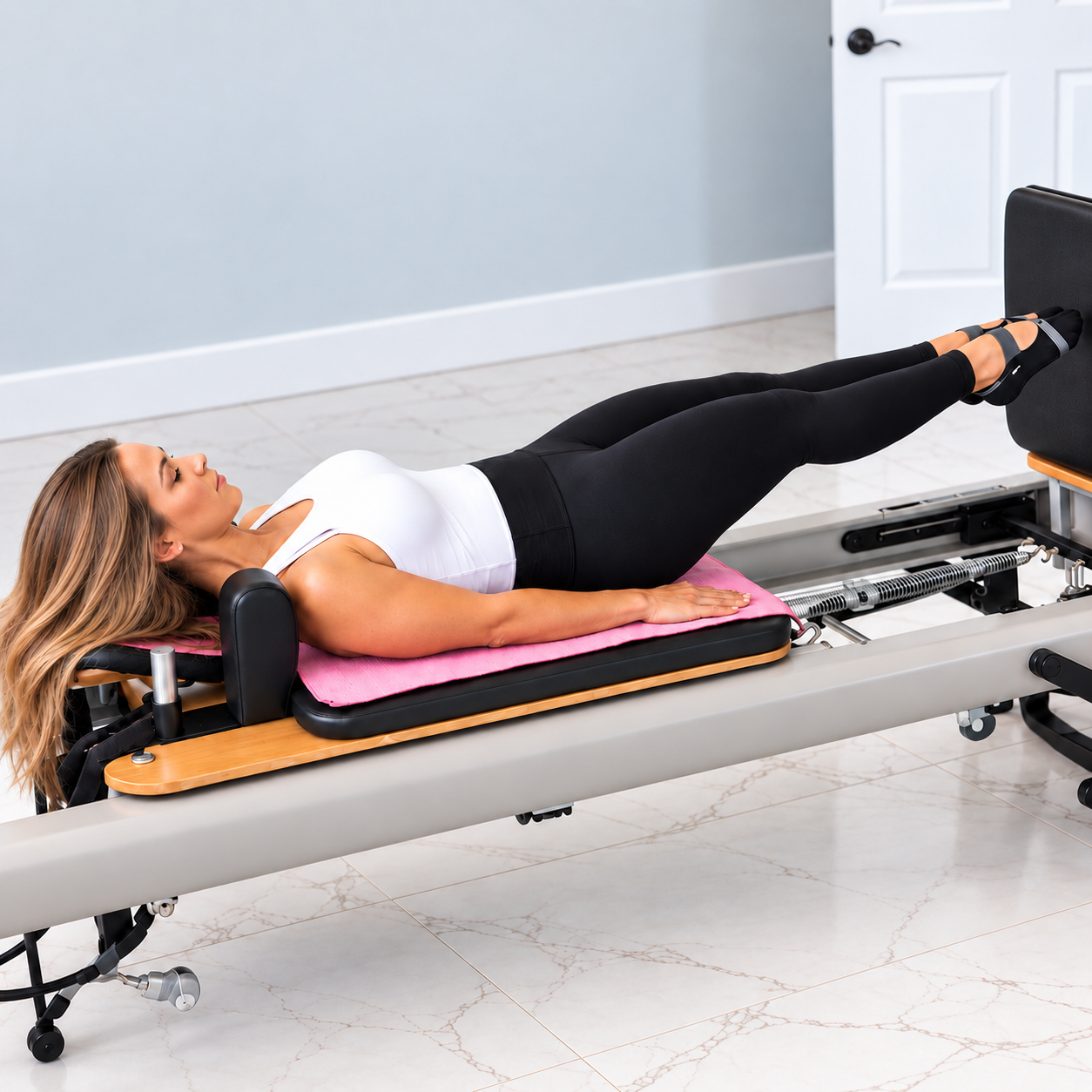
Cardio Jumpboard Reformer requires core control, pelvic stability, lower-body strength, coordination, and the ability to maintain proper hip, knee and ankle alignment while pushing off and landing with control.
3. Your Movement Is Becoming More Precise
Precision is one of the defining ideas behind Pilates. As you become more experienced, you start noticing details that may have escaped you when you were new. Where is your pelvis? Are your ribs lifting? Are your shoulders creeping toward your ears? Are you pushing evenly through both feet? Are you actually using the muscles the exercise is intended to challenge? Progress often looks less dramatic than people expect. Sometimes the biggest improvement is doing a familiar exercise better.
4. Your Transitions Become More Fluid
Pilates is designed to flow. An experienced practitioner usually needs less time to figure out where to put their feet, which way to face or how to set up the equipment. You begin anticipating what comes next.Transitions become cleaner. The entire workout starts feeling less like a list of exercises and more like one continuous movement practice.
5. You Can Handle More Than One Kind of Challenge
A common misconception is that the only way to make an exercise more advanced is to make the movement itself more complicated. Not true. An instructor can progress an exercise in many different ways. We can:
Increase or decrease spring resistance*
Change the speed
Increase time under tension
Increase the range of motion
Add repetitions
Reduce stability or support
Change your body position
Add unilateral work
Add coordination
Combine movement patterns
Reduce rest between exercises
Create more challenging transitions
*And sometimes a lighter spring is actually harder because the springs provide less assistance and your body has to create more control. That’s why “more springs” does not automatically equal “more advanced.”
6. You Can Maintain Your Form When the Difficulty Goes Up
This is one of the biggest differences between simply attempting an advanced variation and actually being ready for it.
When we change the resistance, increase the range, speed up the tempo or make the exercise less stable, can you still maintain your alignment and control? If your form disappears as soon as the challenge increases, the progression may be too much — at least for now. Progress means being able to add difficulty without losing the Pilates principles underneath it.
7. You Know When to Modify
Experienced Pilates clients aren’t necessarily the people who always choose the hardest option. Often, they’re the people who know when not to. They recognize when something feels different from productive muscular effort.
They know that one side of their body may behave differently from the other. They know when a smaller range of motion produces better movement. And they understand that modifying an exercise doesn’t automatically mean making it easier. Sometimes the smartest variation is the most advanced choice you can make.
8. You Need Less Instruction to Find Your Position
Your instructor should always teach and cue you, regardless of your level.
But with experience, you begin to understand the language of Pilates. Neutral pelvis. Imprint.Powerhouse. Shoulders down. Ribs connected. Lengthen through the crown of the head. You know how to organize your body more quickly and can respond to smaller, more detailed corrections. That allows the class to move at a faster pace — something that becomes particularly important in an intermediate workout.
So How Long Does It Take to Become Intermediate?
There isn’t a universal number. Someone who takes Pilates three or four times a week may progress differently than someone attending once a week. Previous movement experience matters. So do injuries, mobility, strength, coordination and simply how quickly you learn the Pilates system. That’s why the number of classes you’ve taken is only one part of the equation. At Renegade Pilates, experience requirements help make sure everyone in a higher-level class has enough familiarity with the method for the group to move safely and efficiently. But your instructor’s assessment matters too.
What About Advanced Pilates?
Advanced Pilates isn’t about proving that you can perform the fanciest exercise on Instagram. The original Pilates repertoire includes increasingly demanding exercises that require significant strength, control, mobility, coordination and familiarity with the system. But advanced practice is also about refinement. Can you create more control? More precision? Better breath? Better flow? Can you make a familiar movement more efficient? Sometimes making a basic exercise look effortless takes far more skill than performing a complicated exercise poorly.
Ready to Level Up?
Our new Level Up Intermediate Reformer class is designed for experienced clients who are ready for more complex exercises, quicker transitions and additional physical challenge. The class requires a minimum of 150 Pilates classes/instructor permission. If you’re not sure whether you’re ready, ask us. Pilates was never meant to be a race through increasingly difficult exercises. It’s a system — and every exercise prepares you for what comes next. The real goal isn’t simply to move from beginner to intermediate to advanced. It’s to become stronger, more precise, more controlled and more confident in the way your body moves.